ODD HOURS / GAME DESIGN
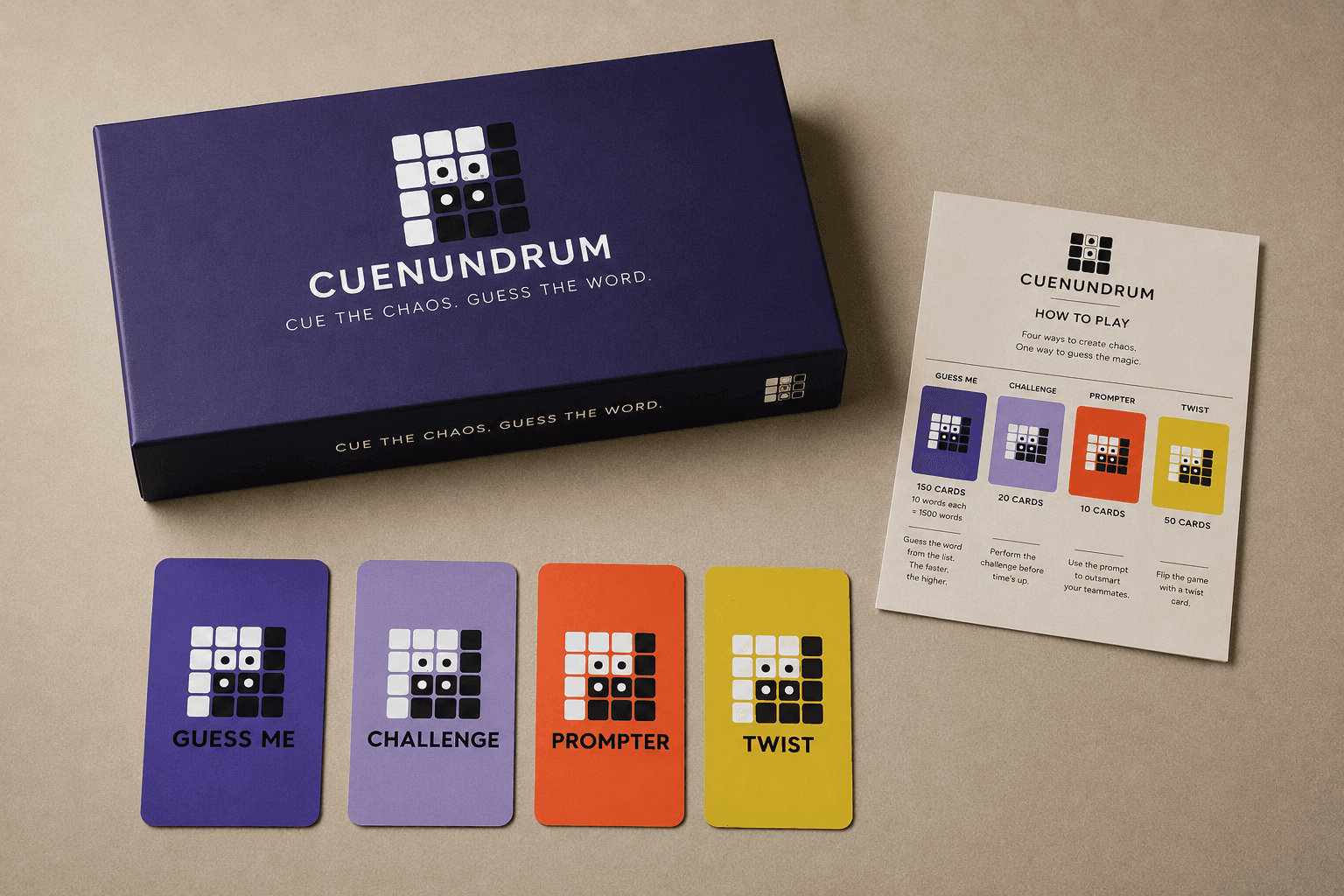
I’ve loved board games for a long time. And for almost as long, I’ve wanted to make one. Not just play them. Make one. My own rules, my own logic, my own reason for getting a group of people around a table and making them pay attention to each other for twenty minutes.
I brainstormed a lot of ideas. Most of them died the same way: they sounded fun in my head, and then I’d try to work out the actual logic. How does a turn begin? What happens next? How do you score? What stops the game from becoming repetitive? Somewhere in that process, the idea would quietly stop making sense.
“I have a small graveyard of game concepts that never made it past a notebook page.”

It started as a word-guessing game, somewhere in the general family of Taboo and Charades. But I wanted a little more unpredictability built into it: challenges, different ways of giving clues, and Twist cards that could suddenly make a familiar round slightly ridiculous. Funny voices. Gestures. Extra time. Choosing between cards. Nothing revolutionary on its own. Just enough to make the game feel different from one round to the next.
Conundrum is a confusing problem. A cue is what you give someone when you’re trying to get them somewhere without saying the thing outright. Put the two together and you get Cuenundrum: a little puzzle created by the cues you’re giving the other person.
150
Guess Me cards
1,500
words agonised over
230
cards in the final deck
The moment it became physical
The Guess Me deck has 150 cards, with ten words on each one. That is 1,500 words that need to be familiar enough to guess, varied enough to stay interesting, and not so obvious that the game becomes boring. I massively underestimated how long that would take.
Eventually, there was a version that held together well enough to print: 150 Guess Me cards alongside Challenge, Prompter, and Twist cards. Then suddenly there was an actual box of cards sitting in front of me. You could shuffle them. You could hand them to someone. You could say, “Let’s play.”
The game and the experience are not the same test
Since then, Cuenundrum has been played with family and friends. Some people have genuinely loved it. Others have not quite understood what I was trying to do. Which, honestly, is useful information.
It seems to work best when I’m the one running it. I clarify something before someone asks, notice when a round is not working, and explain it slightly differently. I didn’t realise I was doing any of this until someone else introduced the game without me there. It didn’t land quite the same way.
“I’d been testing the game and the experience at the same time, without always knowing which one I was actually testing.”
Cuenundrum exists now. It has a physical deck. It has made some people laugh, confused some people, survived things I thought would break it, and exposed things I thought were perfectly fine. I’m not sharing the full rulebook yet because the game is still evolving. But I am still learning from every person who sits down to play it.
I wanted to make something that got people to sit around a table and pay attention to each other. Now I just have to keep making it good enough that they want to do it again.
SHIFALI ROBINSON